Library › Guides › The Bestiary
Slime Girl: Meaning, Origins and Why the Trope Works
By Metavulgar · updated 2026-11-12 · 6 min read

A slime girl is a feminine humanoid made of slime: a body that is soft, translucent, and able to change shape, usually with a personality at odds with the "monster" label. She is a subcategory of the monster girl, the character type where a woman is or looks like a monster. The slime girl takes the amorphous creature from fantasy games and gives it a face, a voice and a way of holding on to you.
What a slime girl is
The basic design is a woman-shaped body of gel. The colour is usually a clear or tinted blue, green or violet, with a visible core somewhere in the chest or head. Her body can stretch, pool, flow around obstacles and re-form. She can often absorb, dissolve or cling, which is how the trope connects to things like consumption and softness.
What she is not is a single fixed creature from myth. There is no folklore slime girl in the way there is a lamia or a kitsune. She is a modern genre invention, built from game design and then given a body.
Where the trope comes from
The pieces come together in three steps.
- Fantasy games. The slime as an easy first enemy became a staple of Japanese role-playing games from the 1980s, and a symbol of the genre. The name echoes older science fiction and horror, where a "slime" was a shapeless threat.
- Monster girl fiction. The Japanese label monster musume ("monster daughter") was coined in 2007 and later became the name of a famous manga series whose slime character made the trope well known. Bestiary-style games and books then sorted creatures into catalogues and gave slimes their own entries.
- Fan culture. Artists and authors took the design and ran with it: slime girls appear in webcomics, visual novels, tabletop settings and, in recent years, audio.
Sources are thin on the exact date of the first slime girl, so treat any single origin story with caution. What is clear is that the game slime came first and the girl came second.
The personality types
Slime girls are almost always written to a few patterns.
- The innocent. Curious, cheerful, a little clueless about human customs. She learns by touching things.
- The clinger. Affectionate to an uncomfortable degree. She wraps around you and does not see the problem.
- The shy one. Hides in a puddle when you look at her, and is relieved when you do not mind.
- The predator with manners. She has a clear plan and a lovely voice. Politeness is how she gets close.
- The sleepy one. Barely holds her shape and loses it when she dozes. Warm, slow, and exceedingly comfortable.
- The experiment. A slime made by a mage or alchemist who is now trying to work out what she is.
Which type works depends on the story. The innocent and the sleepy one dominate comfort writing; the clinger and the predator dominate the dark-fantasy side.
Why the trope works
She cannot hide anything
A slime's body is see-through. Emotion shows in colour changes, ripples, glow. That openness is the opposite of a succubus, who hides everything, and it makes a slime girl feel safe even when she is dangerous.
Softness is the point
The design takes touch seriously: warmth, weight, texture, slow movement. These are exactly the qualities that suit audio, where a listener is asked to imagine feeling rather than seeing.
She is a pure trope
Because there is no single myth to be loyal to, a slime girl can be rewritten from scratch each time. Authors can make her a guardian of a spring, a lab escapee or an ancient being, and nobody argues about accuracy.
It lowers the stakes
A creature that melts, reshapes and sticks to you is physically strange without being threatening in a classic horror way. It is a monster fantasy with the sharpest edges removed.
How slime girls differ from other monster girls
| Slime girl | Lamia | Kitsune | Succubus | |
|---|---|---|---|---|
| Source | Modern games and manga | Greek myth | Japanese folklore | Medieval European demonology |
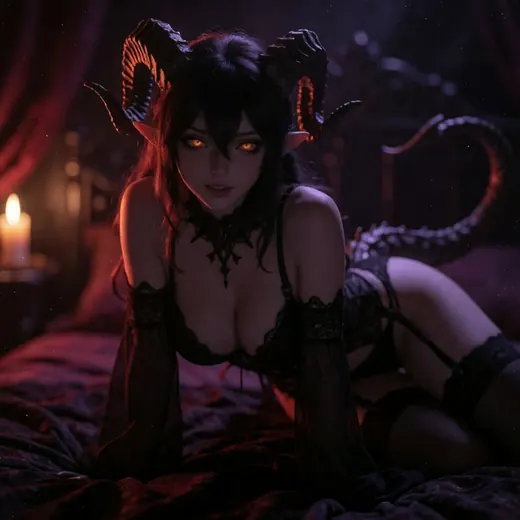
| Body | Gel, shape-shifting | Woman and serpent | Woman with fox ears and tails | Woman with horns and wings |
| Main appeal | Softness, openness | Coils, patience | Trickery, devotion | Control, temptation |
| Typical mood | Warm, curious | Slow, possessive | Playful, wise | Sultry, bargaining |
If you want to see how these differ in practice, compare lamia vs naga and the kitsune guide.
Slime girl in audio
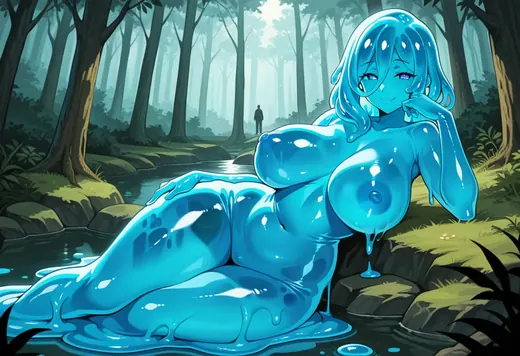
On audio a slime girl is a gift. Sound design can do what a drawing cannot: wet, low, slow, close. The voice does the rest. In my own work the slime girl is gentle and thorough. I write her as a creature who learns what you like by feeling for it and then does not let go. The glowing spring session is the soft version, with a slime who guards a pool and wants you to stay. The violet slime session is a slower, deeper take. Both are adults-only fantasy and both are made for headphones.
If you are new to monster audio, the Start Here course puts a slime girl in the first night, because she is the easiest way in. For the audio-specific version of this page see slime girl ASMR, and for a name list see slime girl names.
Common slime girl designs
The visual vocabulary is small, which is part of why it spreads so easily.
- The pool slime. Lower body is a puddle, upper body is a woman. Easy to draw, easy to describe in audio.
- The full humanoid. Looks like a translucent woman who has been poured into a person-shaped mould.
- The core slime. A bright orb in the chest, which is her heart, memory and self at once. Protecting or touching the core is a recurring beat.
- The hair slime. Hair that is a stream or a drip, and that can reach for you.
- The armoured slime. A slime wearing stolen pieces of adventurer gear, an old joke of the trope.
- The tinted slime. Colour signals temperament: blue for calm, green for curious, violet for knowing, pink for eager.
Slime girl abilities in fiction

Authors pick from a short toolkit.
- Shape-shifting. She changes size, form or even imitates a person.
- Absorption. She takes things into her body and holds them there, safely or not, depending on the tone of the story.
- Regeneration. Damage closes. This is why slime girls are written as hard to hurt and easy to forgive.
- Cling and cushion. The classic: she holds you and you sink slightly into her.
- Temperature. Warm for comfort, cool for tension.
- Weakness. Heat, salt and a damaged core are the usual weak points in game-derived settings.
Slime girl questions people ask
Do slime girls have bones? Usually not, which is part of the softness. Can they speak? In most fiction yes, often in an echoing, close voice. Do they eat? Depends on the author: some absorb, some drink, some simply do not need to. They are the most flexible monster girl because nothing is fixed.
If you want ideas for a character of your own, monster girl OC ideas and monster girl names are good starting points.
Writing a slime girl that feels fresh
The trope is crowded, so a few choices help. Give her a reason to be soft: a spring that heals, a mage who made her kind, a long sleep that left her without edges. Give her one thing she will not dissolve for. Let her colour disagree with her words once, so that the listener learns to read her body before her speech. And decide what she wants from the person in front of her, because a slime who only exists to be cuddled is a cushion, not a character. The best versions hold a quiet want: to be chosen, to be remembered, to stay.
Is a slime girl the same as a "monster girl"?
A slime girl is one kind of monster girl. The larger category also includes harpies, lamias, arachne, dragon girls and many more; the what is a monster girl guide covers the whole set, and the monster girl species list sorts them by type.
Frequently asked questions
What is a slime girl?
A slime girl is a monster girl whose body is made of slime. She usually has a woman's shape, a translucent or tinted body, a visible core, and the ability to stretch and re-form. She is a modern genre character, not a figure from folklore.
Where do slime girls come from?
From fantasy game slimes, which became a staple of Japanese role-playing games, combined with the monster musume genre. The manga Monster Musume gave the type a famous face in Suu. The exact first slime girl is hard to pin down.
What are slime girl personalities like?
Common types are the innocent, the clinger, the shy one, the polite predator, the sleepy one and the experiment. Most are warm and curious, and the contrast with the monster label is the point.
Why are slime girls popular?
Their bodies are soft and see-through, so emotion is visible and nothing is hidden. They are low-stakes, physically unusual, and flexible as characters because there is no single myth to follow.
Are slime girls part of mythology?
No. Unlike lamias or kitsune, slime girls have no folklore source. They are a modern invention built from game slimes and monster girl fiction.
Listen next
Keep reading
- What Is a Monster Girl? Meaning, History and Appeal
A monster girl is a humanoid female fantasy character who blends a person with a creature, myth or spirit: a lamia, harpy, slime, kitsune or succubus. - Monster Girl Species List A-Z: Origins and Personalities
This monster girl species list runs A to Z across 34 adult fantasy beings, from arachne to yuki-onna. Each entry gives the origin, whether Greek, Japa