Library › Guides › The Bestiary
Lamia and Naga Monster Girls: Myth, Coils and Hypnotic Eyes
By Metavulgar · updated 2026-11-13 · 7 min read

The lamia monster girl is the snake-woman of modern fantasy: human face, human torso, and below the waist a long, strong serpent body. She is a blend of two very different traditions. The lamia comes from Greek myth and carries a story of a cursed queen. The naga comes from Hindu and Buddhist tradition and is a semi-divine serpent being, often benevolent. Fiction mixes them, so one character can have a Greek name, an Indian body language and a modern personality. This guide separates the strands, explains the tropes that matter for fantasy and audio, and ends with how I write her.
Lamia in Greek myth
Ancient sources tell several versions, and they disagree. The core story is that Lamia was a queen, in many tellings of Libya, whom Zeus loved. Hera, his wife, punished her. In the most repeated account Hera destroyed what Lamia loved and Lamia's grief and rage made her a monster who preyed on others. Some writers say Hera cursed her with sleeplessness, and Zeus gave her the ability to take out her eyes so she could rest. That detail, the removable eyes, is one of the more unsettling in the myth and one of the more useful for fiction.
Over time the single Lamia became many lamiai: seductive female spirits who lured young men and drained them. A famous later telling comes from the Greek writer Philostratus, in which a philosopher unmasks his student's beautiful bride as a lamia who had taken a feast and a wedding to hide her nature. The story gave English poetry its template, most famously in John Keats's poem Lamia in 1820. That is the origin of the lamia as a beautiful woman who is not what she seems.
The snake body is mostly a later addition. In the oldest sources the lamia is a monster with a woman's upper body, and descriptions vary. The serpent lower half became standard in art and later fantasy.
Naga in Hindu and Buddhist tradition
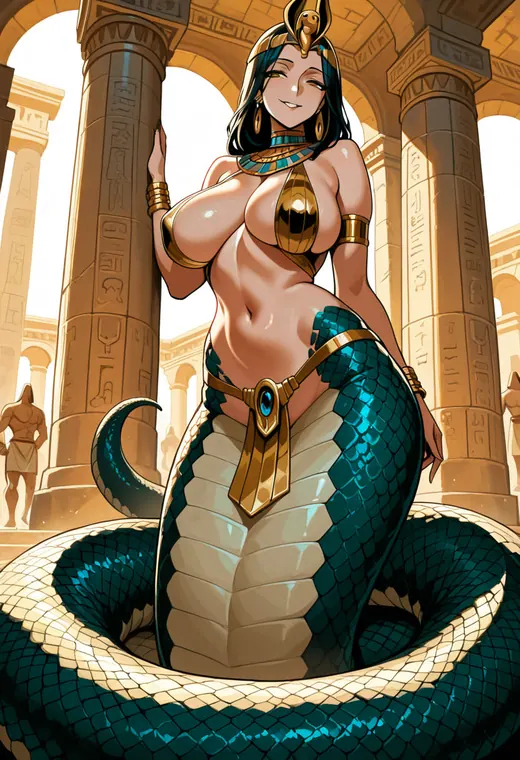
The naga is not a monster in the same sense. In Hindu tradition nagas are serpent beings who live in the underworld realm of Patala or in water. Some are great kings: Shesha (also Ananta), the endless serpent on whom Vishnu rests, and Vasuki, who was used as the churning rope in the churning of the ocean. In Buddhist tradition the naga king Mucalinda shelters the Buddha from a storm with his hood, a scene that appears in a great deal of art. Nagas control water, rain and treasure. They can be fierce when wronged and generous when honored.
A female naga is a nagini (or nagi). Folklore describes nagas who take human form, and nagini appear as beautiful women in many tales. Their serpent form is usually a cobra, and a multi-headed hood is a common sign of rank. They are protectors of waters and keepers of hidden wealth, more guardian than predator.
How the two traditions differ
| Lamia | Naga / Nagini | |
|---|---|---|
| Culture | Greek, later Roman | Hindu, Buddhist, wider South and Southeast Asian |
| Nature | Cursed woman turned monster | Semi-divine serpent being |
| Motive | Hunger, grief, revenge | Guardianship, rank, bargains |
| Body | Woman, later serpentine below | Serpent or human, cobra hood |
| Tone | Dangerous seductress | Protector, sometimes wrathful |
| Weakness | Exposure of her true nature | Disrespect to water and sacred places |
Fiction collapses these. The anime and game tradition of the "lamia" or "naga" monster girl mostly uses the Greek name for the body type and borrows the Indian idea of a regal serpent. If you want a fuller comparison, Lamia vs Naga lays it out in detail, and Lamia Names has names for both.
What a lamia monster girl is in modern fantasy

The template has stabilized into something recognizable:
- Human upper body, serpent lower body, usually a long scaled tail rather than legs.
- Coiling. The tail is strong, muscular and flexible, and she uses it to hold, wrap and keep.
- Warmth versus cool. Snake-bodied characters are often written as cool to the touch, with a heat-seeking tenderness. The contrast is a classic sensory hook.
- A forked tongue and slit eyes as small visual signals.
- A patient personality. Snakes wait. Lamias are often written as unhurried, watchful, amused.
- The gaze. The hypnotic stare is the trope most associated with her.
The coil and constriction fantasy
The coil fantasy is about being held. It is the idea of a body that wraps around yours, applies steady pressure, and does not let go until she decides. It plays on a human liking for weighted blankets and tight hugs, taken into a fantasy register. The pressure is deep and slow, the voice is close, and the whole experience is of being unable to leave and not wanting to.
I write that as consensual fiction. The listener chose the session, the "capture" is a game with rules, and nothing in it is advice for the real world. The pleasure is surrender, with control still in your hands: you can stop the audio at any moment.
For sound, coiling has a language: slow breaths, the soft drag of scales, a low contented hum, and a voice that is half description, half instruction. Coil: Wrapped in the Lamia's Temple is a session built entirely on it, and The Lamia's Coil: Wrapped and Kept is the longer, slower version.
The hypnotic gaze trope

Almost every snake-woman has a hypnotic stare. The trope has a long history: folklore from many cultures describes serpents paralyzing their prey with a look, and storytellers have borrowed it for centuries. Whether any real snake works that way is doubtful; it is mainly a story device, a way of showing a character who controls attention. In fiction it fits the lamia perfectly, because attention is her power. She says look at me, and the world narrows.
In audio, the gaze becomes suggestion: a calm, repeated voice that invites you to follow her words, slow down and let go. That connects it to relaxation hypnosis, where the listener stays in control and can end the session at will. Snake Girl Hypnosis walks through that in detail, and Succubus Hypnosis shows the same ideas with a different monster.
Reading a snake-woman correctly: art, body and personality
Artists give the lamia a few reliable design choices, and each one hints at her personality.
- A long, thick tail that pools on the floor signals patience and a love of comfort. She does not run; she arrives.
- A cobra hood, borrowed from the nagini, signals rank, ceremony and a temple setting.
- Scales that fade into skin at the hips signal a gentle, approachable character, while sharp-edged armor-like scales signal a warrior queen.
- Slit pupils and a faint glow signal that she is looking at you on purpose.
- Jewelry and sashes signal a court, a shrine, a hoard.
When I plan a session I pick two of these and let them drive the voice. A hooded temple guardian speaks slowly, in formal sentences. A soft-scaled hearth lamia speaks like someone who has been waiting by a fire for you all evening.
Why the lamia works so well for audio

Audio loves a character defined by sound and pressure, and the lamia is both. Her body makes sound (a slow, dry slide, a settling of coils) and her presence is a constant gentle weight. Her stillness lets a session slow down, which is what relaxation needs, and her patience lets the pacing stay unhurried even when the scene gets intimate. Add a low voice and a few sentences of suggestion and you have a complete night. That is the reason the snake-woman is one of the first monster girls I teach new listeners to try.
Lamia compared with her neighbors
- Gorgon: snake hair and a stone-turning gaze, not a snake body. See Lamia vs Gorgon.
- Echidna: in Greek myth, the half-woman, half-serpent "mother of monsters". Echidna Meaning and Lore has her.
- Scylla and cecaelia: sea-bodied women with many limbs, not serpents. Scylla Meaning and Lore covers one.
- Siren: voice-led temptation rather than coil-led. Siren Meaning and Lore goes deeper.
How I write a lamia
In my sessions the lamia is old, calm and entirely in charge, a temple guardian or a hidden queen with centuries behind her. She is amused by you, not cruel. The tension comes from her patience: she has all night, and she wants you to have it too. Her voice is low and close, her pacing deliberate, and her reassurance is built into the dominance. She tells you what she is doing before she does it, and she checks in with a smile. Every character is an adult, and the fantasy is consensual in its premise.
Quick FAQ-style answers
Is a lamia a naga? Not in the old myths. Modern fiction often treats them as the same body type.
Is the lamia evil? In Greek myth she is a dangerous figure; in modern romance she is more often a protective, possessive lover.
What does lamia mean? The Greek name is of uncertain origin; in later Latin and English use it names a class of serpent women or vampiric seductresses. Lamia has the short definition.
Where to start listening
If you want a first session, Start Here is the five-night course, one monster each. The whole shelf is at Monster Girl Bestiary. For the lamia specifically, listen to the two coil sessions above, and for the hypnotic angle, Fantasy Erotic Hypnosis covers the basics.
Frequently asked questions
What is a lamia monster girl?
A lamia monster girl is a woman with a serpent's lower body, drawn from Lamia of Greek myth. Modern fiction gives her coils, cool scales, a patient personality and a hypnotic gaze, and often blends in traits of the Indian naga.
Is a lamia the same as a naga?
No. The lamia is Greek, a cursed queen turned monster. The naga is a semi-divine serpent being from Hindu and Buddhist tradition. Fiction merges them, so the names are used loosely for any snake-woman.
Why do snake girls have hypnotic eyes?
It is an old story device. Folklore from many cultures claimed serpents could freeze prey with a look, and fiction kept the idea because it shows a character who controls attention. In audio it becomes calm, repeated suggestion.
What is a female naga called?
A female naga is a nagini, sometimes written nagi. In tradition nagini can take human form and are often described as beautiful guardians of water and hidden treasure.
What does the lamia coil fantasy mean?
It is the fantasy of being held and wrapped by a strong, warm-hearted serpent body, with steady pressure and no way out that you wish to use. It is consensual fiction about surrender, and you can stop the audio anytime.
Listen next




Keep reading
- Lamia vs Naga: Greek Snake Woman or Sacred Serpent?
A lamia comes from Greek myth: Lamia was a Libyan queen whom Hera's jealousy turned into a feared night monster, later painted as a snake-bodied seduc - Lamia vs Gorgon: Myth, Differences and Monster Girl Use
A lamia is one Greek monster, a queen turned predator, later a snake-bodied seductress in fiction. Gorgons are three sisters, Stheno, Euryale and Medu - Snake Girl Hypnosis: Why Lamias and Hypnotic Eyes Go Together
Snake girl hypnosis is the fantasy trope of a serpent woman who holds you with her gaze and a slow, repeated voice. The idea that snakes hypnotize pre