Library › Guides › Kitsune & Yokai
Jorōgumo vs Arachne: Japanese Spider Woman vs Greek Weaver
By Metavulgar · updated 2026-11-12 · 6 min read

Jorōgumo vs Arachne is a comparison of two spider women from opposite ends of Eurasia. The jorōgumo of Japan is a yokai, a spider that takes the shape of a beautiful woman and traps men in silk. Arachne of Greece is a mortal weaver who is turned into a spider by the goddess Athena. Both are famous, both are tied to weaving, and both get blended into the same monster girl design. They are very different creatures with very different stories, and each gives a different flavour of fantasy.
The short version
| Jorōgumo | Arachne | |
|---|---|---|
| Culture | Japan | Greece (told by Ovid) |
| Type | Yokai, a spider that takes human form | A mortal woman turned into a spider |
| Role | Seductress, predator in disguise | Proud artist, punished |
| Method | Beauty, music (the biwa), silk | Skill, pride, a weaving contest |
| Moral | Beauty can hide a trap | Do not challenge the gods |
| Modern monster girl | Elegant, dangerous, elaborate | Patient, craftswoman, melancholy |
| Typical setting | Quiet hut, waterfall, old house | Loom, tapestry, workshop |
The jorōgumo in Japanese folklore

The name is written 女郎蜘蛛, "woman-spider", and also with an older, more elaborate reading that sounds like "entangling bride". The most famous image is by the Edo-period artist Toriyama Sekien, in his Gazu Hyakki Yagyō ("The Illustrated Night Parade of a Hundred Demons"): a spider woman surrounded by tiny fire-breathing spiders.
The best-known tale has a man meet a beautiful woman at a quiet hut or by a waterfall, where she plays the biwa, a Japanese lute. He sits to listen and cannot leave. By dawn he is wrapped in silk, and she is no longer beautiful. Sources tie one version to Jōren Falls on the Izu Peninsula, where a woodcutter who rests by the water is nearly caught.
The popular claim that a spider becomes a jorōgumo after four hundred years is a modern addition, not a classical belief. Treat it as fan lore. The real Joro spider (Trichonephila clavata) takes its common name from the yokai.
What the jorōgumo does
- Shapeshifts into a woman of striking beauty.
- Uses music as a lure.
- Spins silk as a trap, sometimes with fire.
- Commands small spiders as servants.
- Attacks from the upper rooms of a house, in the tales.
Arachne in Greek myth
The standard source is the Roman poet Ovid's Metamorphoses. Arachne is a mortal weaver of Lydia, so gifted that people say Athena herself taught her. She denies it, and challenges the goddess to a contest. Athena weaves the glory of the gods; Arachne weaves their failings, and her work is flawless. Athena tears the tapestry apart and strikes her. Arachne is overcome with shame, and the goddess, in pity, turns her into a spider, so that she can weave forever.
The myth is about pride and craft. Arachne is not a monster by nature, and not a seductress. She is an artist whose skill is the problem. The half-spider woman form is a later fantasy design.
Where they overlap and where they don't

They overlap in three ways:
- Silk. Both use it, as art or as a trap.
- The woman who is also a spider. In modern fiction both end up with a spider's lower body and a woman's torso.
- Women who are punished or feared for their skill.
They differ in intent. The jorōgumo hunts. Arachne makes. In the Greek story the spider is the end of the transformation; in the Japanese story the spider is the real form hidden behind the woman.
Modern monster girl versions
The jorōgumo as monster girl
She is elegant, alluring and dangerous, often in a kimono, often a musician, often with a quiet laugh. The tension in her stories is that the listener knows she is dangerous and chooses to stay. She is closer to the kitsune and the succubus in mood: beautiful, patient, in control. For the Japanese family see jorogumo meaning and lore and jorogumo names.
The arachne as monster girl
She is patient, creative and slightly proud, with a loom or a stack of cloth, a sharp wit and lonely hours. The tension is not danger but attention: she studies you the way she studies a pattern. See arachne spider girl and arachne vs drider.
Which one suits which fantasy
- You want a seductress who is quietly dangerous: jorōgumo.
- You want a gentle, craft-loving partner: arachne.
- You want music in the scene: jorōgumo, and her biwa.
- You want a workshop, thread and measuring: arachne.
- You want a shrine or a hot-spring inn: jorōgumo.
- You want a cave with a lamp and a loom: arachne.
Hear the difference
My spider character is closer to the arachne side: an adult being, centuries old, patient and precise, who winds you in silk and speaks as if every word were a stitch. The spider queen's cave is the session. If you want the Japanese flavour, the nearest sounds in the library are the kitsune lantern shrine and the snow woman's lodge, both with the quiet, formal voice that a jorōgumo would use. Both are fiction in a consent frame, and you stay in control throughout.
New to monster audio? Begin with the Start Here course, or browse the monster girl bestiary. For other comparisons see lamia vs gorgon and nine-tailed fox vs kitsune.
Themes: beauty, craft and fear
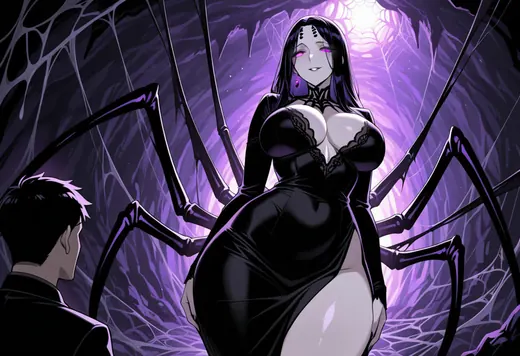
The two stories ask different questions. The jorōgumo asks: what if the beautiful stranger is the danger? It is a tale about trust and disguise, told in a culture with a long tradition of beautiful, dangerous women in ghost stories. Arachne asks: what happens when skill meets pride? It is a tale about hubris and art, told in a culture that values the contest between mortal and god. One is about being deceived, the other about being punished.
For a modern monster girl, that gives two emotional engines. The jorōgumo runs on suspense: you know she is a spider, and the pleasure is in how gracefully she hides it. The arachne runs on intimacy: you are allowed into her workshop and her attention, which she gives to very few. Neither is better. They simply work on different parts of a fantasy.
Real spiders behind the myths
Both stories are rooted in things people noticed about spiders. The Joro spider is a large, brightly marked orb-weaver whose golden silk and big webs would make anyone think of a woman at a loom. The Greek word arachne simply means spider, and the myth explains why spiders weave. In each case a natural fact was turned into a story, and the story gave the creature a face. That is useful for a writer: if you ground the monster in one real trait (golden silk, patient waiting, vibration sensing), the character has texture before she says a word.
Other Japanese yokai women

The jorōgumo is part of a family of Japanese women who are more than they appear:
- Yuki-onna, the snow woman, who appears in a blizzard and freezes travellers.
- Nure-onna, the wet woman, a serpent with a woman's head who waits by the shore.
- Rokurokubi, a woman whose neck stretches at night.
- Kitsune, the fox who takes the form of a woman.
- Futakuchi-onna, the two-mouthed woman, whose second mouth is hidden under her hair.
These are the cousins of the jorōgumo. See yuki onna meaning and lore and nure onna meaning and lore for two of them.
A final choice for writers: decide who sees through the spider. In the Japanese tales it is usually a monk, a woodcutter or a samurai who spots the web before the trap closes. In the Greek tale it is the goddess who sees the flaw in the loom, which is that there is none. A character, human or monster, who can see through the other gives the scene its tension. In audio, that character is you, the listener, and the pleasure is knowing that she knows you know.
Naming your spider character
A Japanese spider woman might be Kumo ("spider" or "cloud", written differently), Ito ("thread"), Orime ("weaving"), Oriko, Tsumugi ("spun silk"), Kinu ("silk"), Biwa (for the instrument), or a title like Jōren no Onna, "the woman of Jōren". A Greek weaver might be Arachne, Ergane, Ariadne or Penelope. A character who draws on both could be given a Japanese given name and a Greek title, with the choice stated.
Frequently asked questions
What is the difference between jorōgumo and arachne?
The jorōgumo is a Japanese yokai, a spider that takes the form of a beautiful woman and traps men with music and silk. Arachne is a Greek mortal weaver who is turned into a spider by Athena after a weaving contest.
What does jorōgumo mean?
Jorōgumo is written 女郎蜘蛛, meaning "woman-spider". An older reading of the same word sounds like "entangling bride". It is also the common name of a real spider, the Joro spider.
Is jorōgumo evil?
In traditional tales she is a predator in disguise who lures men with beauty and music and wraps them in silk. Modern fiction often softens her into an elegant, dangerous or even gentle character.
Does the jorōgumo have a spider body?
In Toriyama Sekien's well-known image she is a spider woman, but most tales stress her human disguise. The woman-above, spider-below monster girl design is a modern fantasy convention.
Are the jorōgumo and arachne related?
No. They arise from separate traditions, Japanese and Greek. They share silk and a woman-spider image, so modern fiction often blends them, but their origins and themes are different.
Listen next



Keep reading
- Arachne vs Drider: Myth, Games and Which Spider Girl You Mean
Arachne is a Greek weaver turned into a spider by Athena, and in modern fiction a woman with a spider's lower body. A drider is a game-born monster, a