Library › Guides › The Bestiary
Arachne vs Drider: Myth, Games and Which Spider Girl You Mean
By Metavulgar · updated 2026-11-12 · 6 min read

Arachne vs drider is a question about two spider women who look alike on a poster. The arachne comes from Greek myth: a mortal weaver who challenged Athena and was turned into a spider. The drider comes from role-playing games, where it is a cursed dark elf with the lower body of a giant spider. In modern monster girl fiction the two get blended, and people use the names interchangeably. This page separates the origins, the bodies, the personalities and the uses.
The short version
| Arachne | Drider | |
|---|---|---|
| Origin | Greek myth (told in Ovid's Metamorphoses) | Role-playing games, from Dungeons & Dragons |
| In the original | A mortal weaver turned into a spider | A dark elf cursed with a spider body |
| Body (modern) | Woman above the waist, spider abdomen and legs below | Elf above the waist, spider abdomen and legs below |
| Theme | Pride, craft, punishment | Betrayal, curse, a spider goddess's will |
| Personality (modern) | Proud artist, weaver, patient | Often tragic, bitter or fierce |
| Setting | Mediterranean myth, modern fantasy | Underdark, dungeons, fantasy worlds |
| Weakness | Fire, light, the loom's thread | Daylight, the curse itself |
Arachne in Greek myth
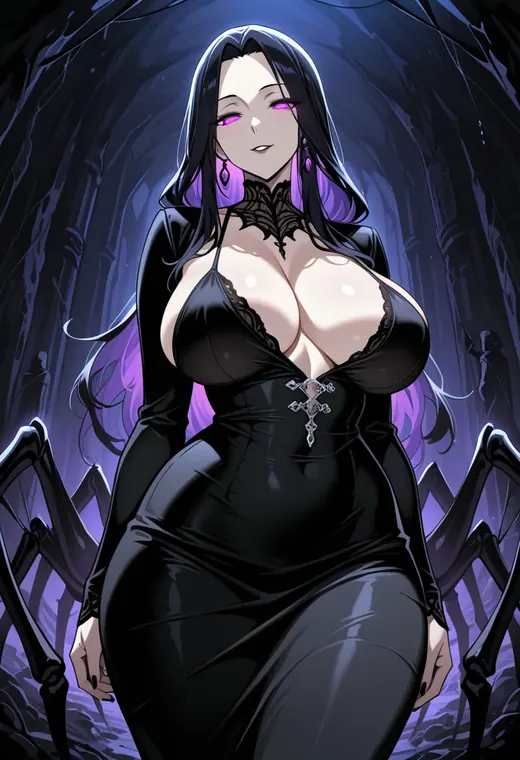
The story most people know comes from the Roman poet Ovid. Arachne is a mortal woman from Lydia, famous for her weaving. She boasts that she is better than the goddess Athena, who is the patron of weaving. Athena appears in disguise and warns her; Arachne refuses to back down. They hold a contest. Athena weaves a tapestry of the gods in glory; Arachne weaves a tapestry that shows the gods' failures, and her work is flawless. In anger, Athena destroys the tapestry and strikes her. Arachne, in despair, is overcome by shame, and Athena, in pity, turns her into a spider so she can weave forever.
The key point for fiction is this: in Greek myth there is no half-spider woman. Arachne becomes a spider outright. The woman-above, spider-below design is a later invention.
The drider in games
The drider comes from Dungeons & Dragons, where it is a drow, a dark elf, who failed the test of the spider goddess Lolth and was transformed. The drider has the upper body of a dark elf and the lower body of a giant spider. It is a monster of curse and failure, often tragic, and a staple of dungeons. The word has since escaped the game and become a general fantasy term for any elf-spider hybrid.
How the two blend in monster girl fiction
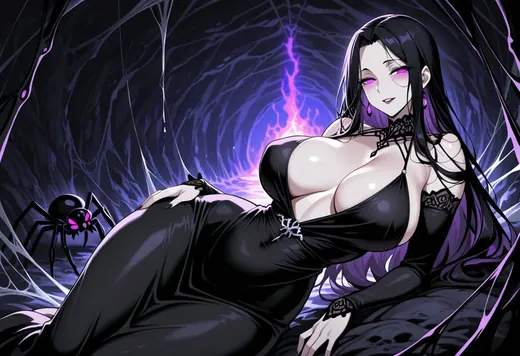
In monster girl fiction both end up with the same design: a woman's torso on a spider's body, eight legs, sometimes extra eyes. The names carry the baggage of their origins.
- Arachne in modern fiction is usually the species name, used for a spider woman: a weaver, an artisan, proud and patient. Fiction often retains the myth's theme of craft.
- Drider is used for a spider woman with a tragic history: cursed, outcast, fierce. It carries the dark-elf backstory.
If your character is a weaver, call her arachne. If she is a cursed outcast, call her drider. If she is both, say so.
Bodies and abilities
Both share a toolkit:
- Silk. Binding, bridges, nests, cradles and traps.
- Extra limbs. Eight legs, plus the arms of the upper body, which makes them excellent multitaskers.
- Climbing. Walls and ceilings are not obstacles.
- Venom. In many tellings she can paralyse, though most monster girl fiction softens this.
- Sensing vibration. Everything that touches the web is a message.
The weaver aspect gives arachne an additional skill: craft. She makes clothes, tapestries and gifts. The drider's additional skill is usually magic, from her dark-elf heritage.
Personality: the difference that matters
An arachne is typically:
- Patient, exact and a little vain about her work.
- Lonely, because her craft takes years.
- Protective of what she has made, including you.
- Teasing in a dry, quiet way.
A drider is typically:
- Guarded, with a sharp tongue.
- Haunted by the curse or exile.
- Fierce when threatened, soft when trusted.
- Proud of surviving.
Neither is a fixed type. These are the patterns authors lean on.
Which one suits which fantasy
- You want a patient, slow, careful voice: an arachne. Weaving is a metaphor for attention.
- You want a tragic, fierce companion: a drider. The curse gives the scenes weight.
- You want a cosy spider cave: an arachne with a loom and a lamp.
- You want an underground fortress: a drider in the dark.
- You want the myth intact: Arachne the weaver before the transformation, who never becomes a half-spider.
Spider women in other traditions
The spider woman is not only Greek. A few relatives help if you want a different flavour for your character.
- Jorogumo (Japan): a spider who becomes a beautiful woman and lures men with music and silk. See jorogumo vs arachne.
- Tsuchigumo (Japan): "earth spider", a mythic giant spider and a name for rebel clans in old chronicles.
- Anansi (West Africa and the Caribbean): a spider trickster who is usually a man, but a good reminder that the spider is a storyteller in many cultures.
- Spider Grandmother (Hopi and Pueblo stories): a creator figure who weaves the world.
- Arachne in painting: Velázquez painted The Spinners, a scene that echoes the contest; many artists have used the weaving myth.
If you mean something older than the monster girl catalogue, these are the places to look.
Naming your spider girl
Names that suit both:
- Arachne herself, if you mean the myth.
- Ariadne, "most holy", a Greek weaver of a different thread, the one that leads out of the labyrinth.
- Penelope, who weaves and unweaves by night in the Odyssey.
- Ergane, "worker", an epithet of Athena.
- Pallas, another epithet of Athena.
- Lolth is a game goddess, so avoid it unless you are writing in that world.
- Silka, Weavra and Tessara are invented names built on silk, weave and tessellate.
For a longer list see arachne names.
A last practical point: if you are searching for audio or fiction with a spider girl, try both terms. Some creators tag "arachne", some "drider", and some "spider girl". Searching all three finds more than any one of them.
A note on size and body
Spider women are written in two sizes. The centaur-sized version has a woman's torso on a body the size of a pony, which gives her presence and a lot of leg. The human-sized version has a woman's body with spider traits: extra eyes, small fangs, silk glands, extra pairs of arms. The first is easier to draw and harder to cuddle; the second is the one that suits audio, because you can imagine being close to her without a diagram.
In my sessions
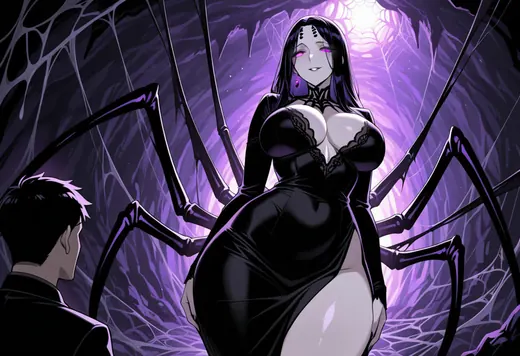
My spider queen is an adult being, centuries old, who weaves and speaks in a low, precise voice. The spider queen's cave is the one to hear: silk, patient hands and a voice that wraps. The lore is borrowed from the weaver myth rather than the game. For the creature in full, see arachne meaning, and for a name list see arachne names. The Japanese cousin is the jorogumo, covered in jorogumo vs arachne. For the wider family, see monster girl species list and the monster girl bestiary. First night? Start Here.
Both terms also turn up as tags and search words for audio, games and art, so a creator who writes "spider girl" may mean either one. Reading the first paragraph of a description tells you which tradition she is borrowing from, and whether she is a weaver, a curse or both.
Common questions
Is arachne a real mythological creature? Arachne is a mortal in Greek myth who becomes a spider. The half-spider woman is a modern design.
Do driders come from Greek myth? No. They come from role-playing games.
Can a drider be a monster girl? Yes. Many fiction works use the term for a spider woman, regardless of elf origins.
Which one is more dangerous? Neither in myth. In fiction it depends on the author. The arachne is more often a patient predator; the drider more often a fighter.
Frequently asked questions
What is the difference between arachne and drider?
Arachne is a Greek myth: a mortal weaver turned into a spider by Athena. A drider is a role-playing game monster, a dark elf cursed with a spider body. Modern fiction often gives both a woman-above, spider-below design.
Is arachne half spider in mythology?
No. In Ovid's version Arachne is turned into a spider entirely. The woman-and-spider hybrid is a later fantasy design, not part of the Greek myth.
Where does the drider come from?
Driders come from Dungeons & Dragons, where they are drow, dark elves, transformed by the spider goddess Lolth as punishment or test. They have a dark elf torso and a giant spider lower body.
Is a drider the same as an arachne?
Not originally. They look similar in modern fiction, so the names are often blended, but arachne is a myth-derived weaver and drider is a game-derived cursed elf.
What is the Japanese version of arachne?
The jorogumo, a spider woman in Japanese folklore who takes the form of a beautiful woman, is the closest cousin. She appears in traditional tales as a seductress who traps her victims in silk.
Listen next



Keep reading
- Jorōgumo vs Arachne: Japanese Spider Woman vs Greek Weaver
The jorōgumo is a Japanese yokai spider who takes the form of a beautiful woman and lures men with music and silk. Arachne is a Greek weaver turned in - Monster Girl Species List A-Z: Origins and Personalities
This monster girl species list runs A to Z across 34 adult fantasy beings, from arachne to yuki-onna. Each entry gives the origin, whether Greek, Japa