Library › Guides › The Bestiary
Gorgon vs Medusa: The Difference, Explained With the Myth
By Metavulgar · updated 2026-11-12 · 6 min read

Gorgon vs Medusa is a question of category and individual. A gorgon is one of three monstrous sisters of Greek myth, or any creature of that kind; Medusa is the best known of the three, and the only one who dies. People use the words as if they were the same because in most stories the gorgon who matters is Medusa. This page separates them, then walks through how the story changed from Hesiod to Ovid, and what each version means for the modern monster girl.
The quick answer
- Gorgon is the group. Stheno, Euryale and Medusa are the three gorgons.
- Medusa is one gorgon, usually the one who appears in the story of Perseus.
- Stheno and Euryale are immortal; Medusa is mortal, which is why she can be killed.
- "The Gorgon" in older writing often means Medusa alone, because she is the one with a story.
| Gorgon | Medusa | |
|---|---|---|
| What it is | A family or species of three sisters | One of the three |
| Others in the group | Stheno, Euryale, Medusa | Her sisters Stheno and Euryale |
| Mortality | Two immortal, one mortal | Mortal |
| Main story | Guard the edge of the world | Killed by Perseus; Pegasus and Chrysaor born from her |
| Name meaning | Linked to gorgos, "fierce, terrible" | Debated: "guardian", "protectress" or "ruler" |
The earliest picture: Hesiod
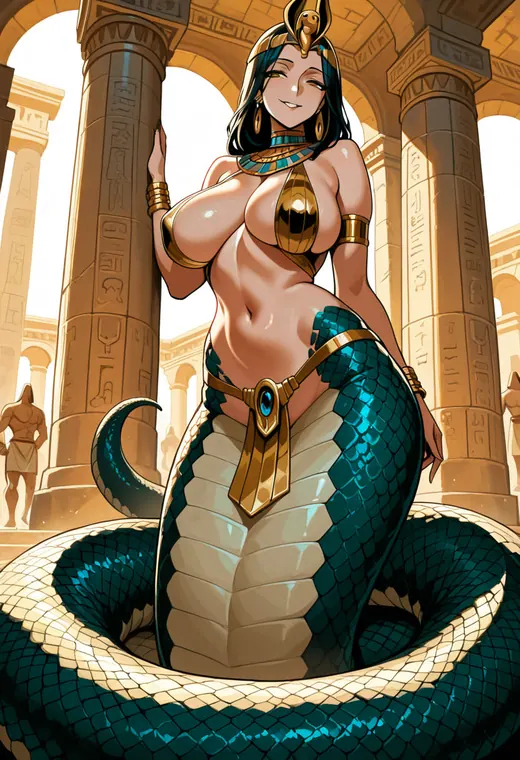
In the Theogony, written around the 7th century BC, the gorgons are daughters of the sea gods Phorcys and Ceto, living far to the west beyond the ocean. They are monsters by birth, not by punishment. Medusa dies when Perseus cuts off her head, and from the wound spring the winged horse Pegasus and the golden-sworded Chrysaor. There is no mention of a curse or a transformation.
At the same time the image of the gorgon was spreading through Greek art as the gorgoneion, a frightening face with wide eyes, tusks and a lolling tongue, used to protect temples, shields, doors and pottery. In that role the face is a guard. This is the origin of the "guardian" reading of Medusa's name.
The later picture: Ovid
The version most people know, in which Medusa was a beautiful woman cursed by Athena, comes from the Roman poet Ovid in the Metamorphoses, written around the start of the first century AD. In Ovid, Medusa is a woman of famed beauty who is violated by Poseidon in Athena's temple, and Athena, in some readings, punishes her by turning her hair into snakes. The tale invites sympathy and has fed centuries of retellings, from sculpture to poetry to modern feminist readings.
The important point is that this is a later development. Hesiod and other early sources do not tell it, and ancient accounts vary. Scholars caution against treating Ovid's version as the myth. If you are writing a character, you can pick either. The monster-from-birth gorgon and the cursed-woman Medusa are different tools.
Perseus, Athena and the head
In the story as most people tell it, Perseus is sent by King Polydectes to bring back Medusa's head. He is helped by gods: Hermes gives him winged sandals and a sickle, Athena lends a polished shield, and he uses the shield as a mirror to approach without meeting her gaze. After the kill he escapes with the head in a bag, and later uses it as a weapon. Athena wears the Gorgon's face on her aegis, her shield or breastplate, which is why the gorgoneion became the sign of divine protection. Some ancient writers said the face on the aegis was a gorgon's rather than specifically Medusa's.
Stheno and Euryale
The immortal sisters rarely get a story. In the Perseus tale they chase him after the beheading and cannot catch him. They remain in the stories as the part that does not die, which is what an immortal gorgon is: a guardian who cannot be removed. In modern fiction they are often rewritten as older sisters, guardians of the temple or a garden, or rivals for Medusa's attention.
How modern fiction uses the two
Gorgon as species
In monster girl fiction a "gorgon" is any snake-haired woman with a petrifying gaze; catalogues of monster girls list the species under the family name. She is usually calm, solitary, proud, and wears something over her eyes.
Medusa as character
"Medusa" is a named character with a history. She appears in games, comics and novels, often as a sympathetic figure. The cursed-victim version is the more common one now, and the monster-from-birth version is used for contrast.
What to call yours
If your character has no history with Perseus and has no sisters, call her a gorgon. If she carries Ovid's story or Hesiod's sisters, call her Medusa. Naming her something else, and calling her a gorgon, avoids borrowing the full weight of the myth.
Medusa in art: how the face changed
The picture of Medusa has changed more than almost any other monster's. Early Greek gorgons are ugly on purpose: round faces, bared teeth, tusks and a long tongue, a warning. By the classical period artists begin to soften her, and in the Hellenistic period some portraits show a beautiful face with wings and snakes, a mourning look and half-closed eyes. That shift is older than the Roman poem and gives the tragic Medusa an artistic root.
Later artists keep both strands. A famous bronze by Benvenuto Cellini shows Perseus holding up her severed head in Florence; Caravaggio painted her at the moment of death on a shield, with an open mouth and live snakes; modern writers have turned her into a symbol of anger, survival and protection. A single figure that can carry all of these readings is why people argue about what she "really" is. The honest answer is that she is several figures under one name.
What the snakes mean
Snakes in Greek thought are not simply evil. They guard the underworld, they heal (the staff of Asclepius), and they stand for the earth. A creature with snakes for hair is, in that frame, a being of the earth and of guardianship. When a modern monster girl has snake hair, she is borrowing that load: she is dangerous because she is protective, and she is lonely because she is feared. It is the opposite of the lamia, whose snake is her body and whose danger is closeness.
Gorgon, Medusa and the stone

Turning to stone is the signature, and there are two ways to write it. In the hard version the stone is a death, and the garden of statues is a graveyard. In the soft version it is a pause: the visitor is held still, kept, and can be returned. My own garden is the second kind, a place where stillness is the gift and the gorgon's attention is the thing you came for. Both are fiction, and both are older than any monster girl catalogue.
Which one makes the better monster girl
The gorgon has more room. She is a species with a protective-symbol past, a gaze that can be a gift or a burden, and no single plot attached. Medusa is a person with a story already told, which makes her heavier and more familiar. I use the species. My gorgon is an adult being, centuries old, with a garden full of stillness, and the voice is the hold. The gorgon's garden session is the closest to what I mean; for the coiled alternative, the lamia's temple. For the comparison with the lamia see lamia vs gorgon, and for the sister list gorgon names. Start at Start Here if you are new.
Writing notes

Decide early whether your gorgon knows she is feared. A gorgon who has never met a person who could hold her gaze has a different voice from one who has watched a hundred visitors turn. Decide what the stone means. Decide whether the snakes speak. Those three choices tell you more about the character than any amount of myth. And whichever version you choose, tell the listener once, early, that she is a grown being with her own mind and her own rules.
Common questions answered quickly
Was Medusa always a monster? In Hesiod, yes. In Ovid, no.
Did Athena curse Medusa? In Ovid's account, in some readings, yes. Other sources do not tell it.
Are all gorgons female? In Greek myth, yes. The three are sisters, and the later fiction follows.
Did she have snakes for legs? No. Snakes in her hair, and in some images at her waist as a belt. Snake tails belong to lamia and naga fiction.
Is "Gorgon" ever a name? Yes: Gorgo was a real Greek female name, borne by a queen of Sparta.
Frequently asked questions
Is a gorgon the same as Medusa?
No. A gorgon is one of three sisters, Stheno, Euryale and Medusa, or a creature of that kind. Medusa is the most famous of the three and the only mortal one.
Who are the three Gorgons?
Stheno, Euryale and Medusa, daughters of the sea gods Phorcys and Ceto in Hesiod. Stheno and Euryale are immortal. Medusa is mortal and is killed by Perseus.
Was Medusa cursed by Athena?
That version comes from the Roman poet Ovid, who describes Medusa as a beautiful woman turned into a monster. Hesiod and earlier sources present the gorgons as monsters from birth, so the curse is a later development.
Why is Medusa the only mortal Gorgon?
Greek sources state it as a fact of the myth: Stheno and Euryale are immortal and Medusa is not. It is what makes her killable and what makes her the center of the Perseus story.
Are gorgons the same as lamias?
No. Gorgons are three sisters with snake hair and a petrifying gaze. A lamia is a separate Greek figure, later imagined with a snake lower body. They are often blended in modern fiction.
Listen next



Keep reading
- Lamia vs Gorgon: Myth, Differences and Monster Girl Use
A lamia is one Greek monster, a queen turned predator, later a snake-bodied seductress in fiction. Gorgons are three sisters, Stheno, Euryale and Medu - Gorgon Names: 80 Greek Names From Myth, With Meanings
The three Gorgons of Greek myth are Stheno ("strength"), Euryale ("far-springer") and Medusa ("guardian" or "ruler"). Beyond them sit their family and