Library › Guides › The Bestiary
Spider Girl Monster: Arachne, Webs and Why She Binds
By Metavulgar · updated 2026-11-13 · 5 min read

A spider girl is a monster girl with a spider's gifts: silk, patience, many-legged grace and a hunter's calm. The archetype has two roots. One is Arachne, the Greek weaver in Ovid's Metamorphoses who was turned into a spider. The other is the Japanese jorogumo, the spider woman who takes human form. Add modern fantasy, where the lower body becomes a full spider abdomen, and you have the figure people search for. This page covers the myth, the tropes, why the web scene is so popular in adult fantasy, and how to tell a spider girl from her neighbours.
The Arachne myth
In Ovid's version (Book 6), Arachne is a mortal weaver from Lydia, so skilled that people think Athena taught her. She denies it and challenges the goddess to a contest. Athena, disguised as an old woman, warns her to be humble, and Arachne refuses. They weave side by side. Athena's tapestry shows the gods' power and the punishment of mortals who defy them. Arachne's shows the gods' failings, including Zeus's many disguises, and it is flawless. Furious, Athena tears it apart and strikes Arachne with the shuttle. Arachne, in despair, tries to hang herself, and Athena turns the rope into a web and the weaver into a spider so that she will weave forever. The Greek word for spider, arachne, gave us arachnid.
Two things matter for the monster girl. First, the story is about craft and pride, so the archetype comes with intelligence and artistry. Second, she is a weaver first: silk is her art, not just her weapon.
The Japanese side

The jorogumo ("binding bride" in one reading of the characters) is a spider that becomes a beautiful woman, lures men to a house or a waterfall and wraps them in thread. She is a trap and a seduction. The monster-girl spider combines the two: Arachne's skill with the jorogumo's allure. Their differences are covered in Jorogumo vs Arachne.
Spider girl tropes
- The web as home. The lair is a woven room, silk hangings, a cocoon bed, dew on threads. The setting is the character.
- Patience. She never chases. She waits and lets you find your way to her. In audio this becomes a slow, unhurried voice.
- Binding as affection. Silk wrapping is the signature gesture. In fantasy it stands for being held so completely that you can stop deciding anything.
- Vibration and touch. Spiders feel through threads. Spider-girl scenes use touch described as signals: one light tug, then a long answer.
- The patient feeder. She wraps you, then takes care of you: warmth, water, quiet.
- The lower body. Many versions use an upper body of a woman and a spider's body below. The related species is the arachne and drider comparison.
- Many arms or eyes. Extra eyes or arms for the more alien design.
Why bondage fans like her
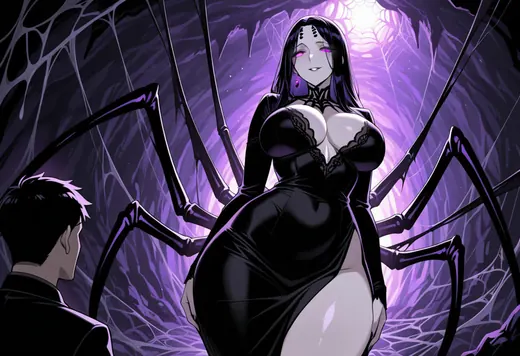
The spider girl is the cleanest vehicle for consensual-feeling restraint in fiction. The web is soft, warm and beautiful. It binds without pain. The power dynamic is part of the appeal: you give up control in a fantasy where the one who holds you is careful, skilled and attentive. In all of my audio the setting is fiction and the listener is in charge: you can stop, skip or shift anytime you like. The tropes work because they are structured: a threat that never turns into harm, a trap that is really an invitation.
Variants of the archetype
Spider girls are not one design. Four versions turn up again and again, and each wants a different voice.
The queen
A grand, patient ruler of a cave or silk palace, with attendants and a great web. She speaks in complete, unhurried sentences and treats you as a guest she has decided to keep. This is the most common version in audio, because her scale gives a scene a lot of room.
The weaver
A craftswoman first. Her silk hangings are the interest: patterns, dyes, the way she works at a loom while you sit near. This is the Arachne of the myth, proud of her skill and a little sharp about it. She is the best fit for a slow, comfortable session, because the scene can be built around the sound of work.
The huntress
Fast, quiet, and precise. She stalks and then pounces, and the web is a tool. The pace is quicker, the voice lower. Even here the story keeps the safe frame: the hunt ends in being held, not harmed.
The lonely one
A spider woman who lives alone in a ruin or an attic and is startled to be visited. She is shy under the confidence and wants company more than she admits. This version is the softest and the one that works best for comfort and sleep.
What a spider girl is not
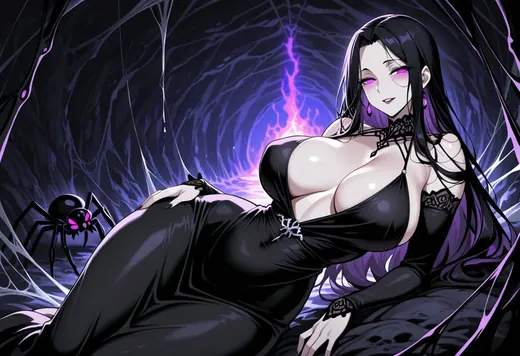
- Not a real spider. The fantasy being is humanoid and adult; it takes the spider's gifts, not its biology.
- Not a villain by default. The lore gives her pride and a grudge. The modern version often gives her a reason to be gentle.
- Not a siren. Sirens call; spiders wait. If you want the voice-led version, see siren meaning and lore.
Silk, symbolism and the reason it lands
Silk is one of the oldest luxury materials and spider silk one of the strongest natural fibres by weight, which is why the image works on two levels at once: it is delicate and it is unbreakable. A spider girl who wraps you in silk is saying the same thing twice. She is gentle and she is not going to let go.
Webs also stand for connection. A spider feels every vibration along the thread, so the web is a nervous system outside the body. In romance this becomes the idea that she notices everything about you: your breathing, the moment you relax, the small change when you want more or less. That attentiveness is what makes the scene feel safe. The listener is not being captured by a stranger; they are being read, closely and kindly, by someone who cares about the answer.
Voice and sound in audio

A spider girl sounds like attention. A low, steady voice, a pace set by pauses, small fabric and thread sounds, and a quiet, certain tone. Her lines are short because she doesn't need to rush. Binaural recordings suit her well, since the sense of being circled and wrapped is partly spatial. If you are curious what binaural means in practice, the glossary entry explains it.
Where to start
The session Web: Wrapped in the Spider Queen's Cave is the direct example: a hunting queen, a silk chamber, a long slow wrapping. For the other end, Steady: Pinned Down in the Minotaur's Labyrinth is a firmer take on being held. If you want her as a name, arachne names has the list; for the pairing with a listener, arachne x reader. And if you are new to the library, Start Here introduces five monsters in the gentlest order. The glossary term arachne is the short version.
Frequently asked questions
Who is the original spider girl in mythology?
Arachne, the Lydian weaver in Ovid's Metamorphoses. She challenges Athena to a weaving contest and is turned into a spider. The Japanese jorogumo is the other major source, a spider that takes the form of a woman.
What are the main spider girl tropes?
Silk and webs, patience, binding as affection, vibration-sensitive touch, a woven lair and the hunter who takes care of what she catches. Some versions add extra eyes or arms, or a spider lower body.
Is a spider girl the same as an arachne?
Often. In monster-girl fiction, "arachne" usually means a woman with a spider's lower body, while "spider girl" can cover any spider-themed woman. Both come from the Arachne myth.
Why do people like webbing and binding fantasies?
The web is soft and careful restraint with no pain, and the fantasy is about trust and giving up decisions to someone attentive. It stays fiction: the listener can stop at any time.
What does a spider girl sound like in ASMR?
Slow, low and deliberate, with pauses, quiet fabric and thread sounds and a steady certainty. Binaural audio helps with the circled-and-wrapped feeling.
Listen next



Keep reading
- Jorōgumo vs Arachne: Japanese Spider Woman vs Greek Weaver
The jorōgumo is a Japanese yokai spider who takes the form of a beautiful woman and lures men with music and silk. Arachne is a Greek weaver turned in - Arachne vs Drider: Myth, Games and Which Spider Girl You Mean
Arachne is a Greek weaver turned into a spider by Athena, and in modern fiction a woman with a spider's lower body. A drider is a game-born monster, a