Library › Guides › The Bestiary
Harpy Girl: Greek Myth, Wings and the Nesting Fantasy
By Metavulgar · updated 2026-11-13 · 6 min read
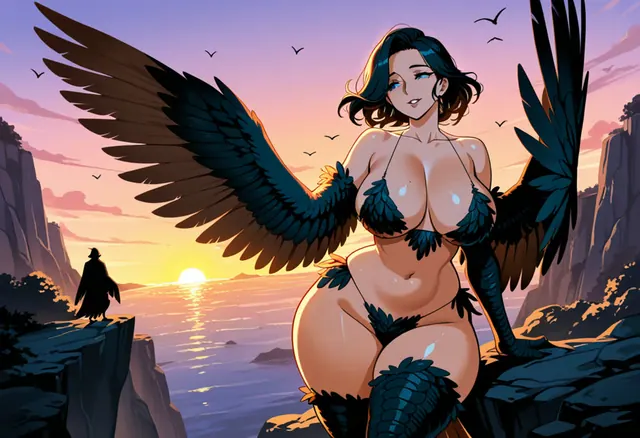
The harpy girl is one of the most vivid monster-girl designs: a woman with broad feathered wings in place of arms, taloned feet, a bird's sharp senses and a voice that can shriek or sing. She comes from Greek myth, where the harpies were something quite different from the winged romantics of modern fiction, and the distance between the two is where the interesting material lives. This guide tells the myth first, then follows it into the modern monster girl and the fantasy that defines her, the nest.
Harpies in Greek myth
The Greek word harpyiai means "snatchers". In the oldest tradition the harpies were storm-wind spirits, personifications of the gusts that seize things and carry them off. When someone vanished without a trace, the old stories blamed the harpies.
Hesiod names two: Aello ("storm wind" or "storm-swift") and Ocypete ("swift-winged"), described as fair-haired winged maidens who flew faster than the winds and the birds. Homer knows one, Podarge ("fleet-foot"), who in the Iliad is the mother of Achilles' immortal horses by the west wind Zephyrus. Virgil adds a third, Celaeno, "dark one", a prophetess.
Later writers made them harsher. In the story of the Argonauts, the harpies torment the blind king Phineus, snatching and fouling his food until Jason's companions, the winged sons of the north wind, drive them off. In that version they are loathsome bird-women with a woman's face, a bird's body, and claws. Authors differ on what happens to them: in some versions they flee and are spared after the goddess Iris intercedes, and in others they are killed. So the picture of the harpy as a hag-vulture is a later development, and the earliest picture is the beautiful, fast, dangerous wind.
From myth to monster girl
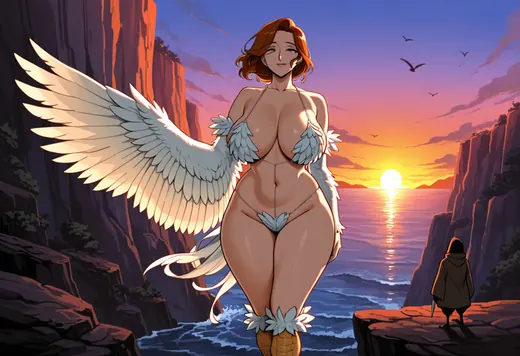
Modern fantasy kept the wings, talons and speed and reworked the personality. The harpy girl is no longer a stealer of meals and a messenger of doom. She is a sky-dweller with the temperament of a bird of prey and a bird of home: proud, fierce, territorial and, once she trusts you, deeply affectionate.
Her common design features:
- Wings instead of arms, sometimes with small hands at the wing joint, sometimes with a wing-and-arm hybrid.
- Feathered legs and taloned feet, strong and sharp, usually careful with a lover.
- A tail of feathers.
- A sharp-eyed, quick face, and sometimes crest feathers.
- A voice with range, from a cry to a song.
- A cliffside home, high, windy and bright.
The harpy's personality
The harpy is built around two instincts.
The hunter's instinct. She is quick, alert, proud and independent. She does not like being cornered, and she likes to test whether you can keep up. A harpy who respects you will race you, tease you and challenge you.
The nester's instinct. Birds build, line and defend a nest. A harpy who has chosen someone will build a place for them, with soft things, warmth and fierce protection. The same creature who dives at an intruder is gentle with the one in her nest.
The contrast is the character. She is wild and tender, loud and careful.
The nesting fantasy

The fantasy that defines the harpy girl is being taken into her nest. A nest is a small, soft, high, protected place, and being invited into one is a deeply intimate gesture. The fantasy has a few recurring beats:
- The carry-off. She finds you on the ground and lifts you into the sky, and you experience the flight as thrilling, not frightening.
- The nest itself. A bowl of feathers, blankets and warm things on a cliff ledge, a ledge above a storm.
- The wing. She folds her wing over you like a blanket, and the weight and warmth are the point.
- The keeping. She decides that you stay, and she is not going to discuss it.
- The storm outside. Wind and rain beat on the cliff while the nest stays warm.
As ever, it is a consensual fantasy. The listener chooses the capture, the story keeps its rules and the audio can be stopped at any time.
Harpy vs siren and other bird-women
Greek myth has several winged women, and they are often confused.
| Harpy | Siren | |
|---|---|---|
| Body | Bird-woman, talons and wings | Bird-woman (early) or fish-tailed (later) |
| Power | Speed, snatching | Song |
| Role | Storm spirit, punisher | Seductress of sailors |
| Modern tone | Fierce nester | Haunting singer |
The earliest sirens were bird-bodied too, which is why the two are often mixed up. Siren Meaning and Lore tells that story, and Banshee vs Siren shows how the keening and singing women compare. Other winged cousins include the moth girl, soft and light-drawn (Moth Girl Names), and the fallen angel, whose wings are a different symbol (Fallen Angel Meaning and Lore).
The senses and the sound
Audio gives the harpy a rich palette.
- Wing sounds: a soft rush of air, the settling of feathers, a gentle beat that moves from one ear to the other.
- Wind: a constant, low presence, to emphasize height and shelter.
- Her voice: quicker and brighter than the lamia's, with a laugh like a call and a hum that can turn into a song.
- The nest: the soft sounds of blankets and feathers, her breath slowing as she settles beside you.
Binaural recording (Binaural) is perfect for flight, because the sound can circle and rise.
Wings, feathers and how to describe them
Detail is what makes a harpy feel real, and a few choices carry a lot of meaning.
- Eagle or hawk wings: broad, strong, proud. A hunter and a warrior.
- Owl wings: soft, silent, patient. A night-keeper, calm and watchful.
- Songbird wings: small, bright, quick. A cheerful and chatty harpy.
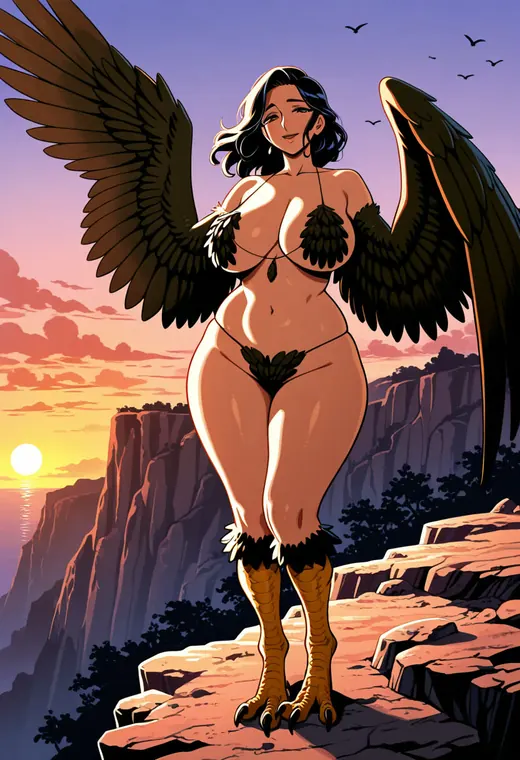
- Raven or crow wings: black and glossy, clever and a little sinister.
- Gull or seabird wings: long and narrow, a coastal harpy who loves wind and spray.
- Peacock or pheasant tails: vain and glorious, a harpy who loves to be seen.
When I plan a session I choose the bird first, because it decides the voice. An owl harpy whispers, a hawk harpy speaks in short, clear sentences, and a songbird harpy hums as she talks.
What the nest is made of
A nest is a description exercise, and a good one is concrete and sensory.
- The frame: woven branches, driftwood or old rope, wedged into a cliff.
- The lining: her own molted feathers, wool, moss and torn silk.
- The treasures: shiny things she collects, coins, bits of glass, a ribbon you once dropped.
- The warmth: her body heat, a small fire, the press of her wing.
- The view: a valley below, clouds at eye level and a storm moving in.
Listeners remember the lining and the treasures more than the plot, so I spend time on them.
Harpies in art and literature after Greece
Harpies did not stop with the Greeks. Roman writers repeated and extended the stories, medieval bestiaries pictured them as bird-bodied women with long claws, and Dante placed them in the wood of the suicides in his Inferno, where they feed on the leaves of the trees. In heraldry, a harpy with a woman's head and an eagle's body appears on coats of arms. That long afterlife is why the harpy is so recognisable, and why modern fantasy can play with her freely.
Which fantasy it suits
- Being carried away: harpy, absolutely.
- Being sheltered from a storm: harpy, the nest and the wing.
- Being challenged and teased by a proud lover: harpy.
- Being held still and slowly kept: a lamia or gorgon might suit better.
- Being sung to: a siren.
Where she lives in my library
I have two harpy sessions. Nest: Sheltered in the Harpy's Cliffside Aerie is the gentle one, all warmth, wing and wind, and Perch: Caught in the Harpy's Storm Nest is the more playful and stormier one. Both are adult characters, centuries old in their own stories, and both are fiction. If you are new to the shelf, Start Here is the five-night course, one monster each, and Monster Girl Bestiary lists them all. For names, Harpy Names has a full list, and Monster Girl Types places her among the other kinds.
Quick answers
What does harpy mean? The Greek word means "snatchers". In modern use it names the bird-woman monster girl, and in older English slang it was also an insult for a shrewish woman, a meaning I do not use.
Are harpies evil? In the later myths, they are punishers and pests. In modern fantasy, they are usually proud, fierce and affectionate.
Can a harpy fly? In most fiction, yes, with strong wings. Some designs have wings that are more for show or short glides.
What is a harpy's weakness? Cold, rain and being caged, in many designs, and in myth, the winged sons of the north wind.
Frequently asked questions
What is a harpy in Greek mythology?
Harpies were storm-wind spirits whose name means snatchers. Hesiod names Aello and Ocypete as fast winged maidens, Homer names Podarge, and later writers made them bird-women who snatched food and people.
What is a harpy girl?
A harpy girl is a modern monster girl with bird wings, talons and often feathered legs. She is usually written as proud, quick and fierce, and very affectionate once she trusts someone, with a nest as her signature fantasy.
What is the difference between a harpy and a siren?
A harpy is a winged snatcher tied to storm winds, known for speed and claws. A siren is a seductress known for her song. Early sirens were bird-bodied too, which is why the two are confused.
Why do harpies build nests in fantasy?
Because birds nest, and the nest is a vivid image of shelter and trust. Being invited into a harpy's nest means being chosen, kept warm and protected, which is the heart of the harpy fantasy.
What are the names of the harpies?
Hesiod names Aello and Ocypete. Homer names Podarge. Virgil adds Celaeno. The names mean roughly storm wind, swift-winged, fleet-foot and dark one, though sources vary.
Listen next




Keep reading
- Banshee vs Siren: Irish Death Omen or Greek Deadly Song?
A banshee is an Irish fairy woman whose keening warns that someone in a family is about to die; a siren is a Greek bird-woman whose song lures sailors - Monster Girl Types: 16 Species Compared at a Glance
Monster girl types are the species of adult fantasy women who are part person and part myth: lamia, harpy, arachne, slime, kitsune, oni, succubus, wer